
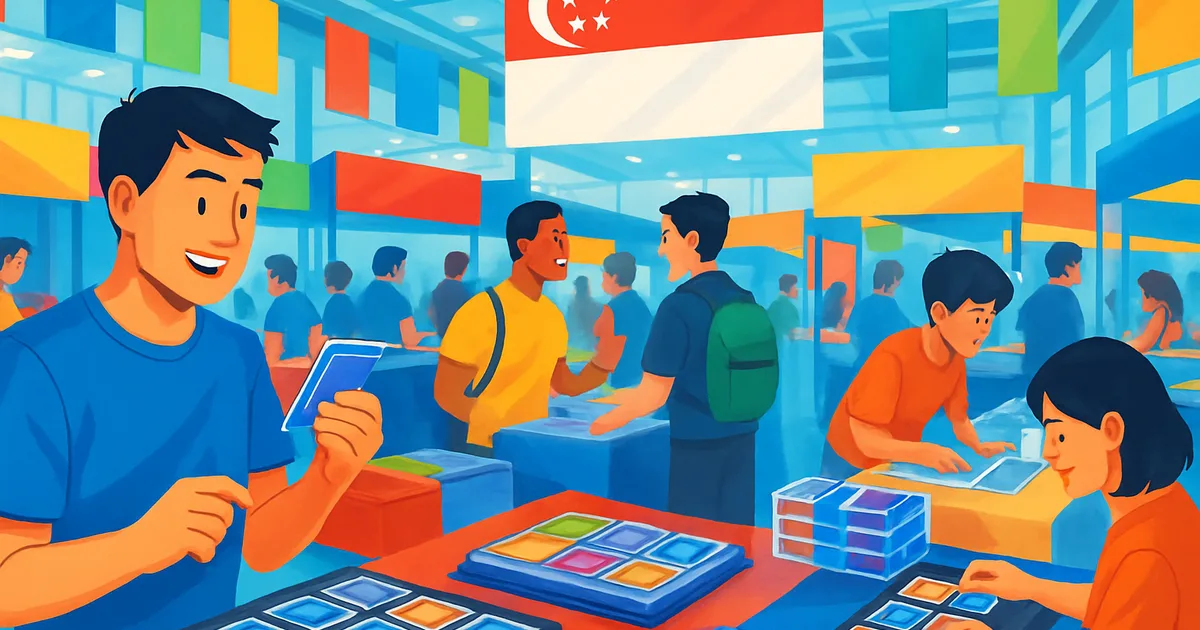
Before you pay for a raw card, a graded slab or a sealed product at a Singapore card show, run through a short routine: confirm the exact item and its variation, inspect its authenticity and condition, compare matching sold transactions rather than asking prices, agree on the final terms in SGD, and keep evidence for anything high-value. The examples below mention Pokémon and One Piece because they are familiar, but the same discipline applies to Yu-Gi-Oh!, Magic: The Gathering, Digimon, Dragon Ball, Union Arena, Weiss Schwarz, sports cards and anything else on the table. Card shows are a great place to buy — most vendors are genuine hobbyists — and a calm checklist simply protects both sides.
- Identify the precise card and variation before anything else.
- Inspect condition first, then discuss value.
- Use authenticity checks appropriate to that franchise and release.
- Verify a graded card's certification through the grader's own official source.
- Compare matching sold transactions, not active listings alone.
- Record the details of any high-value purchase.
What to bring to a Singapore card show
Preparation makes the safety checks easier. A short kit covers most situations:
- Fully charged phone and a power bank
- A small torch (or a spot with good lighting)
- Card sleeves and semi-rigid holders
- A trade binder
- A written wish list and a firm spending limit
- Notes or a spreadsheet of the cards you are trading
Keep your valuables secure and avoid visibly carrying large amounts of cash. New to the hobby? Our beginner's guide to collecting covers the basics before you spend at an event.
The 10 checks to cover before you pay
1. Confirm the exact card
Similar-looking cards can differ enormously in value, so confirm every attribute: franchise and character, set name, card number or code, language, rarity, and whether it is a regular, parallel or alternate-art version. Also check for a promotional or event stamp, foil / non-foil / reverse-foil treatment, and any edition or print variation. For Pokémon that often means the card number, set, language, holo treatment and any promo stamp; for One Piece it means the card code, parallel artwork, manga rare, promotional version and language.
2. Check authenticity using the correct reference
Card stock, print quality, texture, foiling and security features vary by franchise, language and print run, so there is no single universal test that proves any card is genuine. Compare the card against verified examples from the exact same release. Warning signs worth a closer look include incorrect colours or fonts, blurry printing, wrong dimensions, unusual card stock, missing or inaccurate texture, incorrect foiling, spelling or layout errors, and a card back that does not match genuine examples. Never use damaging tests such as ripping or bending a card.
3. Inspect raw-card condition under good lighting
Angle the card under a light and check the front and back for centring, corner and edge whitening, scratches, print lines, dents, creases, surface impressions, binder marks, and any warping or moisture damage. Look for signs of cleaning, recolouring or alteration. Remember that a seller calling a card "near mint" is describing it, not guaranteeing a grade — the same card can score very differently once professionally graded.
4. Verify graded slabs
For PSA, BGS/Beckett, CGC and other graded cards, search the certification number on the grader's own official website or verification service, then confirm the card name, card number, grade and label details match the slab in your hand. Inspect the case for cracks, unusual seams or signs of tampering, and compare its construction and label with known genuine examples. Treat a matching certification number as one check, not absolute proof on its own — and remember that different grading companies do not all carry the same market acceptance or resale value.
5. Compare the correct sold transactions
Value should be anchored to completed sales that match on card and set, card number, language, variation or artwork, raw-versus-graded condition, grading company and grade, and approximate sale date. An active listing is an asking price, not a sale. Use several recent transactions where you can, and when converting overseas prices to SGD, account for currency conversion, shipping, taxes and marketplace fees. Our guide to checking TCG sold prices in Singapore walks through where to find reliable comparables.
6. Agree on the card, condition and final price
Before money changes hands, both parties should confirm which exact card is being sold, its disclosed condition, the final price in SGD, whether sleeves, magnetic holders or other accessories are included, the payment method, whether the sale is final, and any problem-resolution terms the vendor offers. Avoid assuming broad refund rights — remedies depend on the seller, the transaction and the circumstances.
7. Keep cards within sight during a trade
Complete one trade at a time. Each party states the agreed value, both people re-check the cards, and everyone counts everything before binders or bags are closed. This simple habit protects both sides from accidental mix-ups as well as deliberate card switching.
8. Inspect sealed products and mystery offers
For sealed boxes and packs, watch for damaged or inconsistent wrapping, re-glued packaging, broken seals, boxes that look resealed, and missing or questionable distributor markings. Be cautious with prices dramatically below the normal market, "guaranteed hit" claims without clear written terms, and mystery packs that do not disclose odds, conditions or prizes. A very low price is not proof of fraud on its own — treat it as a reason to verify further before paying.
9. Record high-value purchases
For anything expensive, photograph the front and back of the card, record the slab and certification number, and note the event, date, vendor name and booth number. Keep a receipt or written acknowledgement, save the payment record, and note any condition issue the seller disclosed before payment. Always ask permission before photographing a vendor or another attendee.
10. Walk away when warning signs appear
Some signals justify pausing the deal: being pressured to pay immediately, a refusal to allow reasonable inspection, certification details that do not match, value justified only through active listings, payment requested to an unrelated account, the card being taken away and swapped after inspection, a claim that a raw card is "guaranteed PSA 10", or terms that change once payment is being prepared. Missing a deal is always better than completing a purchase you cannot verify.
Raw cards versus graded cards
Raw cards put the weight on your own physical-condition and authenticity checks, so lighting and careful comparison matter most. Graded cards shift some of that work onto the grader, but they add a second job: verifying both the card and the slab. If grading is part of your buying decision, our card-grading guide for Singapore collectors and the breakdown of grading costs and turnaround times explain what grading involves without repeating it here.
What to do if a problem is discovered later
If something looks wrong after you get home, stay calm and methodical:
- Preserve the card, slab, packaging and payment evidence.
- Do not alter, clean or open the item.
- Contact the vendor with clear photographs and the transaction details.
- Review any written event or vendor policies.
- Seek appropriate platform, payment-provider or authority assistance when it is warranted.
This is general guidance, not legal advice, and a refund cannot be guaranteed — outcomes depend on the seller and the situation.
Mobile card-show checklist
Save this to your phone and run through it before you pay:
- Correct card and variation confirmed
- Authenticity checked against a verified example
- Front and back inspected under good light
- Slab certification verified on the grader's official source
- Matching sold prices reviewed
- Final price and condition agreed in SGD
- Payment recipient confirmed
- High-value purchase recorded
About this guide. Written and reviewed by the TCG.SG editorial team — Singapore collectors who buy, trade and grade across multiple TCGs. This is an evergreen guide and is updated periodically as authentication and grading practices change.
Disclaimer: this guide is general information to help you buy more safely. It does not guarantee the authenticity, value or grading outcome of any card, and it is not legal advice. Authentication characteristics vary by franchise and release — always verify important details against a current primary source before a high-value purchase.
Heading to your next card show?
Save this checklist before you go. You can also use TCG.sg to record cards you are considering, organise your collection and review relevant market references before you complete a purchase — so the decision at the table is the easy part.