
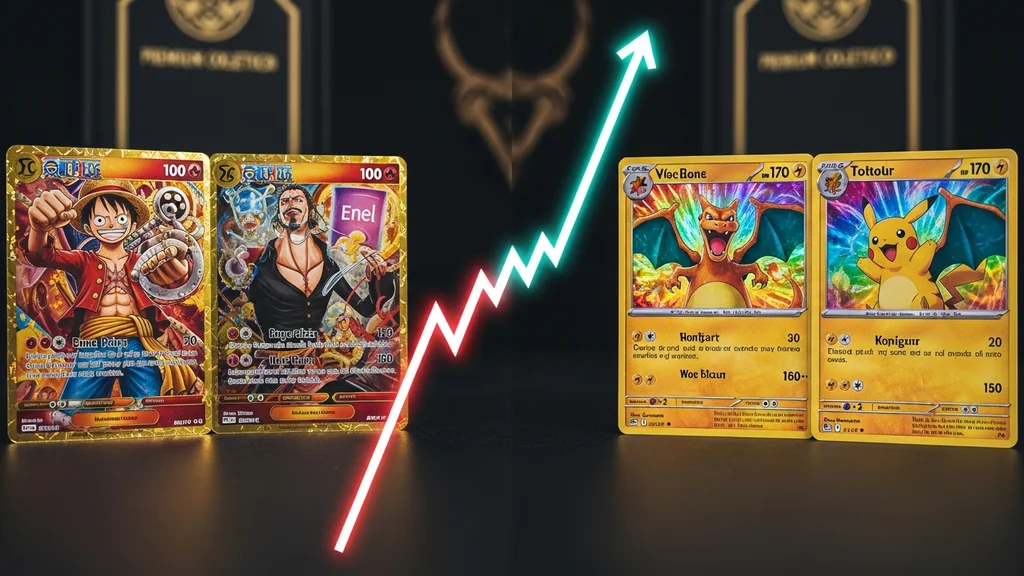
With One Piece OP-15 Adventure on Kami's Island launching in English on 3 April 2026, a question that many Singapore collectors are asking has never felt more urgent: is One Piece TCG now a genuine rival to Pokémon as an investment vehicle?
Pokémon has been the undisputed king of the trading card game secondary market for decades. The 2020–2021 boom — fuelled by Logan Paul, YouTube unboxings, and pandemic boredom — turned PSA-graded Charizards into headline news. But the landscape has shifted dramatically since then, and One Piece is the card game that is most aggressively eating into Pokémon's dominance.
The Pokémon Baseline
Pokémon TCG remains the largest and most liquid TCG market in the world. Key data points:
- PSA has graded more Pokémon cards than any other TCG by a wide margin — the Pikachu Illustrator alone has over 60 graded copies at PSA
- Base Set Charizard 1st Edition PSA 10 sold for over USD $420,000 in 2022 at PWCC
- Population reports for modern Pokémon sets run into the hundreds of thousands per card
- The 2026 Mega Evolution era brings a fresh narrative hook after Scarlet & Violet ended in 2025
The downside for investors: the enormous print runs of modern sets mean PSA 10 populations are huge. Scarcity is harder to engineer when Pokémon prints millions of booster packs per release.
One Piece Growth Metrics
One Piece TCG was launched by Bandai in 2022 and has grown at a pace that surprises even veteran collectors. By early 2026, PSA's grading submission volume for One Piece has surged — with OP-01 and OP-07 secret rares appearing consistently in the top trending submissions.
What makes One Piece compelling from an investment standpoint:
- Lower print runs per region — Bandai's English print allocations are smaller than Pokémon's, meaning individual card scarcity is structurally higher
- Manga rare variants — unique artwork pulled directly from the original Eiichiro Oda manga panels, with no equivalent in Pokémon. OP-15 introduces Dual-Manga chase cards via the EB-04 Extra Booster crossover
- PSA population growth — collectors are increasingly grading One Piece cards for the first time, creating a wave of early low-population submissions
- IP strength — One Piece is the best-selling manga of all time, with the franchise showing no signs of slowing down
Top OP-01 alternate art cards like Monkey D. Luffy SEC (OP-01 Token) have traded above SGD $800 raw and considerably more in high grades. As the population report matures, early PSA 10 submissions gain a first-mover advantage.
Dragon Ball Super TCG and Union Arena as Context
One Piece is not the only challenger to Pokémon's throne. Dragon Ball Super TCG (Bandai's earlier TCG effort) showed that anime IPs could build passionate secondary markets. Union Arena, launched in 2023 with licenses covering popular anime titles, targets the casual to mid-level collector. However, neither has achieved the breakout collector momentum that One Piece is sustaining in 2026.
PSA Grading Demand Comparison
The decision to grade a card — and pay SGD $30–80+ per submission depending on tier — is the clearest signal of collector confidence in future value. PSA's own data shows One Piece climbing the charts in 2025 and 2026, overtaking Dragon Ball Super in new submission volume. This matters for Singapore collectors: local PSA middlemen are reporting a dramatic increase in One Piece bundles relative to Pokémon, a reversal from just two years ago.
The PSA Value and Bulk tiers were historically the entry point for budget grading of modern Pokémon cards. The same economics now apply to One Piece — and given the lower populations, a PSA 10 on a current One Piece card may carry more scarcity premium in three to five years. For grading costs in 2026, see our comprehensive grading costs guide.
Tournament Scene Driving Prices
Unlike Pokémon's organised play structure, One Piece TCG tournaments are growing rapidly in Singapore. Stores like Paradigm, Ark TCG, and Rowell TCG run regular One Piece locals. When a leader card dominates the tournament meta, its price often doubles within weeks — a dynamic less visible in Pokémon's more stable tournament scene. This creates short-term price volatility that savvy collectors can exploit.
Risk Factors: Bandai Reprints
The single largest risk for One Piece TCG investment is Bandai's willingness to reprint. Pokémon's reprint history has frustrated collectors — Master Ball pull rates were diluted by reprints, and sealed product prices collapsed faster than expected. Bandai has been somewhat more restrained with One Piece, but collectors holding large sealed box positions should monitor reprint announcements carefully.
Bandai Premium Booster sets (like OP-07's reprint wave) can temporarily suppress raw card prices while benefiting sealed product values. Diversifying between raw singles, graded copies, and sealed boxes reduces single-point exposure.
Singapore Collector Verdict
One Piece TCG is not replacing Pokémon — but it is providing a higher-risk, higher-reward alternative that suits collectors comfortable with IP volatility. For Singapore collectors operating at a mid-tier budget (SGD $200–1000 per month), the sweet spot is grading early-set One Piece alternate arts with low PSA populations before the Western market catches up.
Pokémon remains the safer, more liquid long-term hold. One Piece offers the kind of asymmetric upside that Pokémon's massive market rarely provides today. The answer to "which is the better investment?" is increasingly: both — with allocation size calibrated to your risk appetite. Read our card grading guide for Singapore collectors and our overview of TCG market growth across Asia in 2026 for more context. For historical perspective on big-ticket Pokémon sales, see the Logan Paul $16.5M Pikachu Illustrator sale.